
Guide
Is a Medical Certificate Required for One-Day Sick Leave?
9 Oct 2026
Sick before an exam or a deadline? Get a medical certificate for university after a real-time consultation with an AHPRA-registered GP, if clinically appropriate.

Universities generally want evidence of when you were affected and how the health condition affected your ability to study, complete an assessment or sit an exam. A certificate that only says "unfit for work" may not address the academic requirement.
This page forms part of the student medical certificate service and focuses specifically on university evidence requirements.
Check your university first
Evidence wording and application rules differ between institutions. Read the current policy before your GP consultation.
| University | What its current guidance asks the evidence to show |
|---|---|
| UNSW | What happened, when it happened and how it affected your ability to complete the assessment. |
| University of Melbourne | Consultation date, impact on the assessment, dates and duration of that impact, plus verifiable practitioner details and signature. |
| Monash University | That you were unfit to complete the assessment by its due date and the period for which you were affected. |
| UTS | The circumstances, academic impact, duration, practitioner identity and required professional details. |
| ANU | When the condition began or worsened, dates of impact and the practitioner's opinion on how it affected course requirements. |
The common thread is professional clinical opinion. The GP can record only what the consultation and available information support, so expect questions about the assessment, deadline and effect on study as well as symptoms.
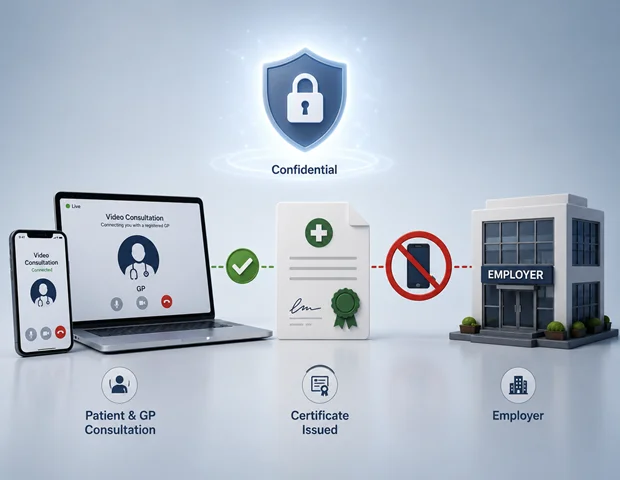
OMC Health certificates follow a real-time consult with a GP. The consultation happens by phone or video rather than through an online questionnaire alone.
UNSW
Online medical certificates need confirmation that a real-time phone or video consultation occurred.
Melbourne
A medical certificate without a consultation is not accepted. The consultation may be in person or by telehealth.
Monash
Some applications require an in-person consultation, although phone or video may be accepted where attending in person was impractical.
No form-only pathway
Monash normally rejects documents from online providers where no phone or video consultation occurred.
Monash application type matters
For extensions longer than 10 days, mid-semester or in-class tests, presentations, practical assessments, deferred exams and rescheduled deferred exams, Monash says acceptable medical documentation must come from an in-person consultation, or phone/video where attending in person was impractical.
University of Sydney is more restrictive
USyd's current guidance says telehealth documentation is accepted only where arranging an in-person consultation was impractical. It also warns that online certificates without the face-to-face and existing doctor-patient relationship requirements it describes will not be accepted.
Do not assume telehealth acceptance
A clinically valid certificate does not guarantee that a university will accept it for a particular academic process. Check the institution's current policy before booking.
We operate as a platform that connects you with trusted Australian medical practices in three simple steps:
Select the student medical certificate type on the OMC Health booking page, upload the university special consideration form, and tell us a bit about your situation.
We connect you with an available AHPRA-registered GP from one of our partner practices for a real-time phone consultation.
If the GP determines it's clinically appropriate, your certificate is digitally issued and emailed the same day.
Book a Student Medical Certificate for a real-time consultation with an AHPRA-registered GP. From $9.99
Some universities use their own medical or professional authority form. If your institution provides one, upload it during booking so the GP can review the practitioner section during the consultation.
UNSW
Uses a Professional Authority Form as one option for medical supporting evidence.
ANU
Provides an optional Health Assessment Form for a health professional to complete.
UTS
Its Professional Authority form requires both an AHPRA practitioner registration number and Medicare provider number for relevant health practitioners.
UTS requirement to check before booking
Confirm that the issuing GP can provide every identifier required on the UTS form before relying on OMC Health to complete it. The GP completes only information that is clinically appropriate and supported by the consultation.
Phone is generally the default consultation mode. The GP decides whether video is clinically needed. Students under 18 require a parent or guardian to book on their behalf and be present during a video consultation.
Current application windows
| University | Process | Current timing |
|---|---|---|
| UNSW | Special Consideration | Generally within 3 working days of the affected assessment or exam. |
| Melbourne | Special consideration | No later than 4 business days after the assessment due date or missed class. |
| Monash | Extension / special consideration | By 11:55 pm on the day the assessment is due or scheduled. |
| UTS | Special consideration / Alternative Exam | Attended central exam: within 48 hours excluding weekends. Missed central exam: use the Alternative Exam process. |
| University of Sydney | Special consideration | No longer than 3 working days after the due date, exam, missed class or placement. |
| ANU | Extenuating Circumstances Application | Within 5 working days of the assessment due date or scheduled exam. |
Rules rechecked 9 October 2026. Always confirm your university's current process before applying. A valid medical document does not fix a missed administrative deadline automatically.
UNSW Fit to Sit
UNSW says that if you sit or access a timed assessment on the scheduled date, you are generally no longer eligible for Special Consideration for being unfit to sit it.
Unwell before the exam
See a medical practitioner promptly, obtain evidence covering the exam date and lodge the application within the required timeframe.
Become unwell during it
Stop the assessment and notify the exam supervisor or relevant course authority immediately. UNSW requires medical evidence dated within 24 hours for this pathway.
UNSW can consider exceptional cases where a student could not reasonably judge their fitness, but this is assessed case by case. A certificate obtained later does not automatically undo an assessment attempt.
A plain timing example
A student who becomes too unwell to finish an essay on its due date books a same-day consultation, explains the due date and study impact, then submits the certificate or university form through the institution's process. Waiting until after the university deadline can create an administrative problem even when the medical evidence itself is clinically valid.
Application pitfalls
Universities make the academic decision, and each institution lists circumstances or documents it may reject. A certificate supports the medical evidence. It does not guarantee special consideration.
Melbourne
Brief or planned internet or power interruptions, public transport delays and personal travel plans are among circumstances it lists as ineligible.
Minor or foreseeable issues
Sydney and UTS apply eligibility rules that can exclude circumstances that do not sufficiently affect your ability to complete the assessment.
Backdated documents
Monash requires an explanation when medical documentation is backdated. Sydney says its team does not have to accept backdated evidence without sufficient clinical justification.
International documents
Melbourne says international medical certificates are not accepted for students studying onshore.
Document authenticity matters
Melbourne may verify documents with the issuing person or organisation. Falsified documents can lead to serious university misconduct consequences, including suspension or expulsion.
Monash also offers a two-calendar-day short extension for many eligible assessments. A first short-extension request for an assessment in a unit does not require a reason, but the option excludes areas such as group assessments, in-class tests, practicals, mid-semester tests and scheduled final assessments.
Each guide focuses on that institution's evidence wording, forms, deadlines and special consideration process. Check the guide for your university before booking and again before submitting your application.
More university guides are being added
Additional guides for UNSW, Melbourne, Monash, UTS, Sydney, ANU and other universities are planned as the university hub expands.
Call 000 in an emergency. OMC Health does not provide emergency care.
General information only, not a substitute for personalised advice; speak with a qualified practitioner.

Your consultation is conducted by an AHPRA-registered GP from one of 20+ partner practices across Australia. The certificate is issued under that GP's own registration.
Ask the university exactly what was missing. Common gaps are its own practitioner form, a description of how your study was affected, or dates that don't cover the assessment. If a GP can supply what's missing, book a follow-up consult and upload the university's form. The GP only records what the new assessment supports.
Yes, it helps. Have the names, due dates and exam times of the assessments you missed or struggled with. The GP certifies the dates your health was affected, based on the assessment, not the dates you'd like covered. Matching those dates to your assessment window makes it easier for your university to assess your application.
Yes. A GP can assess whether your health affected your ability to sit the exam. If appropriate, they issue a certificate to support a special consideration or deferred exam application. Some universities, such as UTS, route missed central exams through a separate process. Our medical certificate for a missed exam page covers exams in more detail.
One certificate covers the period the GP assessed. If several assessments fall within that period, you can attach the same certificate to each application. Your university may still require a separate application for each assessment. For anything due after the certified dates, you'll need a further consult and a new certificate.
When mental health is the reason, the consult happens on video. Seeing you helps the GP consider your current symptoms, how they affect your study and your safety. The GP then decides whether a certificate is appropriate. If you're in crisis right now, call Lifeline on 13 11 14 before thinking about a certificate.
A university medical certificate supports a special consideration, extension or deferred exam request. Universities such as UNSW, Melbourne and Monash look for evidence from a real consult, not a questionnaire. An AHPRA-registered GP can complete your university's own form, if clinically appropriate. Upload the form when you book.