

Guide
How Employers Verify a Telehealth GP Certificate, AHPRA Check and QR Code Guide
25 Sept 2026
Short answer: no, not while symptomatic. Here's why vertigo and driving don't mix, and how to stay safe at home during an episode.
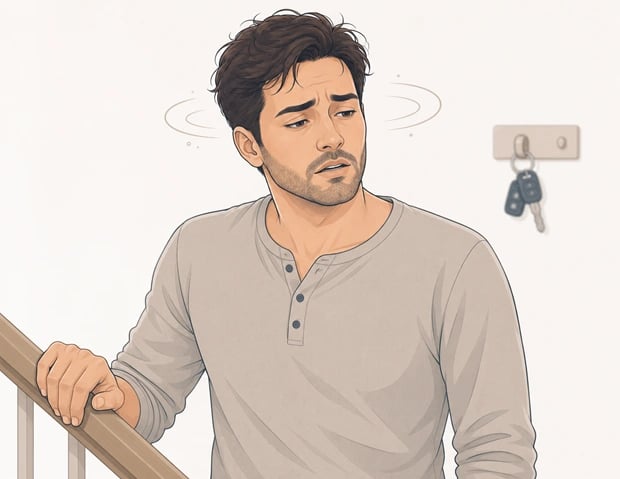
Vertigo can cause a sudden loss of spatial awareness or balance, which is particularly dangerous behind the wheel. Even a brief episode while driving significantly increases the risk of an accident, for you and everyone else on the road, which is why staying off the road and off work if your job involves driving is usually the safer call.
Benign paroxysmal positional vertigo (BPPV), tiny calcium crystals shifting out of place in the inner ear, is one of the most common causes and is often triggered by rolling over in bed or tilting the head back. Vestibular neuritis, an inner ear infection or inflammation, is another frequent cause and tends to bring on more constant, severe symptoms that last for days. Knowing which pattern fits your experience can help you describe it more precisely when you do seek care.
Vertigo does not create one universal "fit" or "unfit" answer. Active spinning or imbalance is incompatible with driving and can also make machinery, ladders, scaffolds and other balance-dependent work unsafe. A passenger commute or low-risk remote desk work may present a different risk profile. The relevant decision is therefore the task and safety exposure while symptoms are active, not just whether the person can physically leave home.
Driving or operating mobile plant
An unexpected episode of spinning, visual motion or imbalance can have immediate consequences when controlling a vehicle or machine.
Heights and balance-dependent duties
Ladders, scaffolds, uneven surfaces, patient handling and other duties that depend on stable balance need a higher threshold for return.
Passenger travel or remote work
Not driving does not automatically mean complete work incapacity. Where symptoms are mild and the work is low risk, the GP can assess whether alternative duties or remote work are realistic.
New neurological symptoms
Weakness, speech change, double vision, severe new headache or other neurological signs need urgent assessment rather than routine certificate management.
Benign paroxysmal positional vertigo (BPPV), the most common cause of vertigo, has a lifetime prevalence of around 2.4% of the population, according to a systematic review published in Frontiers in Neurology. Whether vertigo affects your licence is a separate question from whether you feel unwell. Assessing Fitness to Drive, the national medical standards used by every Australian licensing authority, notes that Ménière's disease may include acute vertigo that can affect driving, and treats short-term episodes as a clinical judgement rather than a licensing matter. This is why a GP assessing vertigo will focus on whether you can safely drive or operate machinery, not only on how dizzy you feel.
For a broader look at vertigo and work capacity, visit vertigo and work capacity. Recurring episodes may need further assessment by your regular GP or an ENT specialist. Healthdirect's overview of vertigo explains the difference between vertigo and general dizziness, and when it's serious.
OMC Health provides real-time consultations with AHPRA-registered GPs, 7 days a week. If the GP determines a certificate is clinically appropriate, it's emailed the same day, from 9.99.
No. Vertigo specifically involves a false sensation of spinning or movement, while lightheadedness is more like feeling faint or unsteady. The distinction matters because they point to different underlying causes.
Sit down immediately when symptoms start, avoid sudden head movements, use handrails, and improve lighting in bathrooms and stairwells if episodes are frequent.
Recurring episodes are best followed up with your regular GP, who can arrange further investigation or referral to a specialist if needed.