

Guide
How Employers Verify a Telehealth GP Certificate, AHPRA Check and QR Code Guide
25 Sept 2026
A modified duties certificate allows injured or unwell workers to return to adjusted work, specifying what they can and cannot do. Here is how GPs assess and document work restrictions.
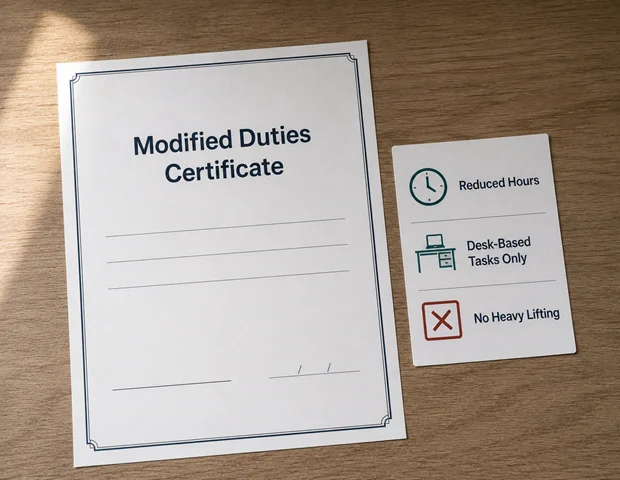
A modified duties certificate is a type of fitness for work certificate. Rather than stating 'not fit for work', it states the specific activities the person can and cannot perform. This allows the employer to provide suitable alternative duties and the employee to return to earning income earlier.
| Restriction type | Common examples |
|---|---|
| Postural | No prolonged sitting beyond X minutes, no bending and twisting |
| Mobility | Limited walking, sedentary work only |
| Cognitive | Reduced hours, no high-concentration tasks, no driving |
| Safety-critical | No driving, no operating machinery, no working at heights |
| Exposure | No dusty environments, no chemical exposure, no extreme temperatures |
Employers, particularly larger organisations, have Work Health and Safety obligations to provide suitable duties to workers recovering from injury or illness where reasonably practicable. This is particularly formalised in WorkCover schemes across all states, where return to work planning is a statutory obligation.
During the consultation, the GP will ask about: the nature of the illness or injury, the specific physical and cognitive demands of your role, your current functional capacity, recovery timeline and any treating specialist's recommendations. The GP then documents specific, measurable restrictions that reflect the clinical picture.
The more clearly you can describe your specific work duties, the more accurate and useful the GP's restriction recommendations will be. Bring a copy of your position description or a clear description of your typical working day to the consultation.
Modified duties is appropriate when you are partially fit, able to perform some but not all of your duties. Full sick leave is appropriate when you are completely unfit for work. The GP determines which certificate is clinically appropriate based on your assessment. For WorkCover claims, the Certificate of Capacity has specific fields for suitable duties recommendations.
A modified duties certificate typically covers a defined period, often 1–4 weeks, with a review date. The GP reassesses at the review date and either continues the restrictions, modifies them as recovery progresses, or clears the employee for full duties. This progressive return is standard in work health and safety practice.
If you need a certificate, OMC Health provides real-time AHPRA-registered GP consultations 7 days a week. From 12.99. Full refund if the GP determines a certificate is not clinically appropriate.
A modified duties certificate specifies what work activities a person can and cannot safely perform during recovery. Instead of certifying full absence, the GP outlines specific restrictions, allowing the employee to return to suitable alternative work while recovering. Issued as a fitness for work certificate from 12.99.
Physical restrictions (no lifting above X kg), postural requirements (no prolonged sitting, no bending), mobility limitations (sedentary work only), cognitive restrictions (reduced hours, no driving), and safety-critical exclusions (no machinery operation, no heights).
Typically 1–4 weeks with a review date. The GP reassesses at the review and adjusts restrictions as recovery progresses.
Similar but distinct. A modified duties fitness for work certificate is used for general employment. A WorkCover Certificate of Capacity has state-specific requirements and is used for workers compensation claims. Both document work capacity and restrictions.
If your employer cannot provide suitable modified duties matching your certificate restrictions, they may need to pay you for the period of incapacity regardless. Seek advice from the Fair Work Ombudsman or a workers compensation lawyer for your specific situation.