
Guide
Are Online Medical Certificates Legal and Valid in Australia?
5 min read14 Nov 2026
Here's how to get a medical certificate online from a registered doctor, and what to expect before a certificate is issued.

For a medical certificate issued by a doctor, look for three things: a registered doctor, a real-time consult and the doctor's own clinical assessment. If one is missing, the certificate may be harder to rely on. Every online medical certificate from OMC Health starts with that real-time consult.
The consult part comes from the Medical Board of Australia's telehealth guidelines, which set professional expectations for doctors. Providing healthcare without a real-time direct consultation, in person, by video or by phone, is not good practice and isn't supported by the Board.
If you're too unwell to work, a sick leave certificate covers the days the GP supports, if clinically appropriate.
The Board's guidelines describe how a doctor opens a telehealth consult. They introduce themselves and confirm your identity as well as they can. They also seek your informed consent, the same as in a clinic.
Then the assessment starts. The guidelines ask doctors to keep checking that telehealth fits the problem. When it doesn't, they should organise a face to face visit, even partway through a consult. They also ask doctors to record the type of technology used and any technical issues.
A tick-box form leaves no room for any of that. That's the difference.
A phone call counts as a real-time consult under the Board's guidelines. Video isn't always needed, so a medical certificate without a video call is often possible.
At OMC Health, phone is the default. The GP decides when video is needed, for example to see an injury. For patients under 18 and for carer's certificates, the GP also chooses phone or video. A parent or guardian joins the consult for anyone under 18.
Doctor's certificate and medical certificate mean the same document here. So if you're working out how to get a doctor's certificate for work, these steps apply. If you're still weighing up where to get a medical certificate, your regular GP may suit an ongoing problem better.
Find a quiet spot where nobody can overhear you, because you'll be discussing your health and your work. Healthdirect's virtual care guidance says to let the provider know if you're not in a private space or others can overhear you.
Write down the first day you felt unwell, plus any days off so far. If your employer or university gave you a form, save the PDF where you can find it. OMC Health has no form library, so you upload your own copy at booking. Any practitioner sections are completed only where the GP finds that clinically appropriate.
Check your notice, too. Fair Work wants your employer told promptly that you're taking leave, so give an idea of how long you expect to be away. A certificate doesn't replace that message.
Expect questions about when your symptoms started, how they affect you now and what your job involves. The GP may also ask about past episodes, anything you've tried and whether you need care beyond a certificate.
Answer plainly. Include the dates you've already missed. Have your employer's evidence requirements handy if you know them.
Good medical practice is the Medical Board's code, and its section 10.9 deals with certificates. It asks doctors to be honest and not misleading in them. Doctors also need to check the content before they sign, and to leave out nothing relevant on purpose.
For a GP, that means the consult has to give them enough to stand behind each date. The NSW Health Professional Councils Authority says a certificate should rest on facts the doctor knows. Those include their own observations and what the patient tells them.
The same guidance covers days that have already passed. A doctor can issue a certificate after sick leave has started, if it names the days they think you couldn't work. They can also decline when they aren't confident about the circumstances.
Be straight with them.
A clear account of the dates, and what you couldn't do on each, gives a doctor something real to certify. Vague answers give them nothing to stand behind, and they may decline.
A booking doesn't mean a certificate will be issued. The GP decides whether one is clinically appropriate, and they may suggest in-person care instead if the problem calls for an examination.
Before you book, check that the service says clearly what happens to your payment if no certificate is issued. At OMC Health, each flat fee and the refund if the GP declines are listed under medical certificate pricing.
Some symptoms need a hospital, not a call. Healthdirect says to go to an emergency department if you're seriously ill or injured. It names symptoms such as breathing problems, loss of consciousness, uncontrollable bleeding, and chest pain or tightness.
In any emergency, Healthdirect says to ring triple zero (000) for an ambulance. For less urgent problems it points to urgent care clinics, your own GP, a pharmacist or its helpline on 1800 022 222.
Your call can end with a pointer to in-person care. That's part of the consult, not a failure of it.
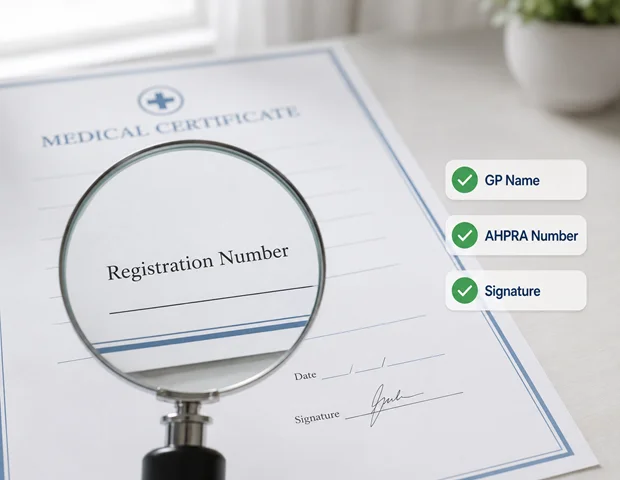
Before you forward it, read it through. Check your name, the consult date, the dates you're covered for and the doctor's name and registration. A labelled sample of what a medical certificate looks like shows where each detail sits.
You can confirm a doctor is registered on Ahpra's register of practitioners. An OMC Health certificate also carries a certificate ID and QR code. Your employer can enter either one to verify a medical certificate without seeing your clinical details.
You can search that register by name or registration number. Ahpra says a practitioner may be registered under a different name from the one they're known by, so try both. Its page also says a practitioner on the register is authorised to practise, with any listed restrictions.
NSW's Health Professional Councils Authority sets out what a certificate should contain. Its list gives a useful checklist, though it's NSW guidance and your employer may ask for more.
| What to check | What it tells you |
|---|---|
| Your name | The certificate is about you |
| Consult date | The day the doctor assessed you |
| Period covered | The first and last day you're certified |
| Doctor's name and practice details | Who issued it, and who to look up on the register |
| Date written and signed | When it was finalised |
Spot a mistake? Ask for a corrected copy before you send it on. It takes a minute.
General information only, not a substitute for personalised advice; speak with a qualified practitioner.
No. You can book with just your email address, and a sign-in link or one-time code is sent there. Once your certificate has been delivered, you're invited to sign in. Doing so keeps a record of your certificates and makes your next booking quicker.
It depends on demand on the day. The estimated wait for your consult is 20 to 40 minutes after booking. Keep your phone close, because the GP will usually ring you. If they approve a certificate, it's emailed soon after the consult.
Yes, you can make the booking on their behalf. The person the certificate is for must take part in the consult, though, because the GP has to assess them directly. The certificate is issued in their name, not yours, and they answer the GP's questions themselves.
No. OMC Health runs through its website, so there's nothing to install. You can book on a phone, tablet or computer, whichever is easiest when you're unwell. Just make sure the phone number you enter is one you'll answer, since that's how the GP reaches you.
Yes. OMC Health uses secure systems to protect your personal and medical details through booking and the consult. Your information is handled confidentially. It's accessed or shared only as needed to provide your consult, process your booking, or meet legal and regulatory requirements.