
Guide
How Employers Verify a Telehealth GP Certificate, AHPRA Check and QR Code Guide
14 Nov 2026
Wondering what a medical certificate looks like before you send one to work? Here are the parts a typical certificate carries, with a labelled OMC Health sample.
Fair Work doesn't prescribe a layout. Its guidance on evidence says the kind of evidence isn't strictly fixed, as long as it would convince a reasonable person.
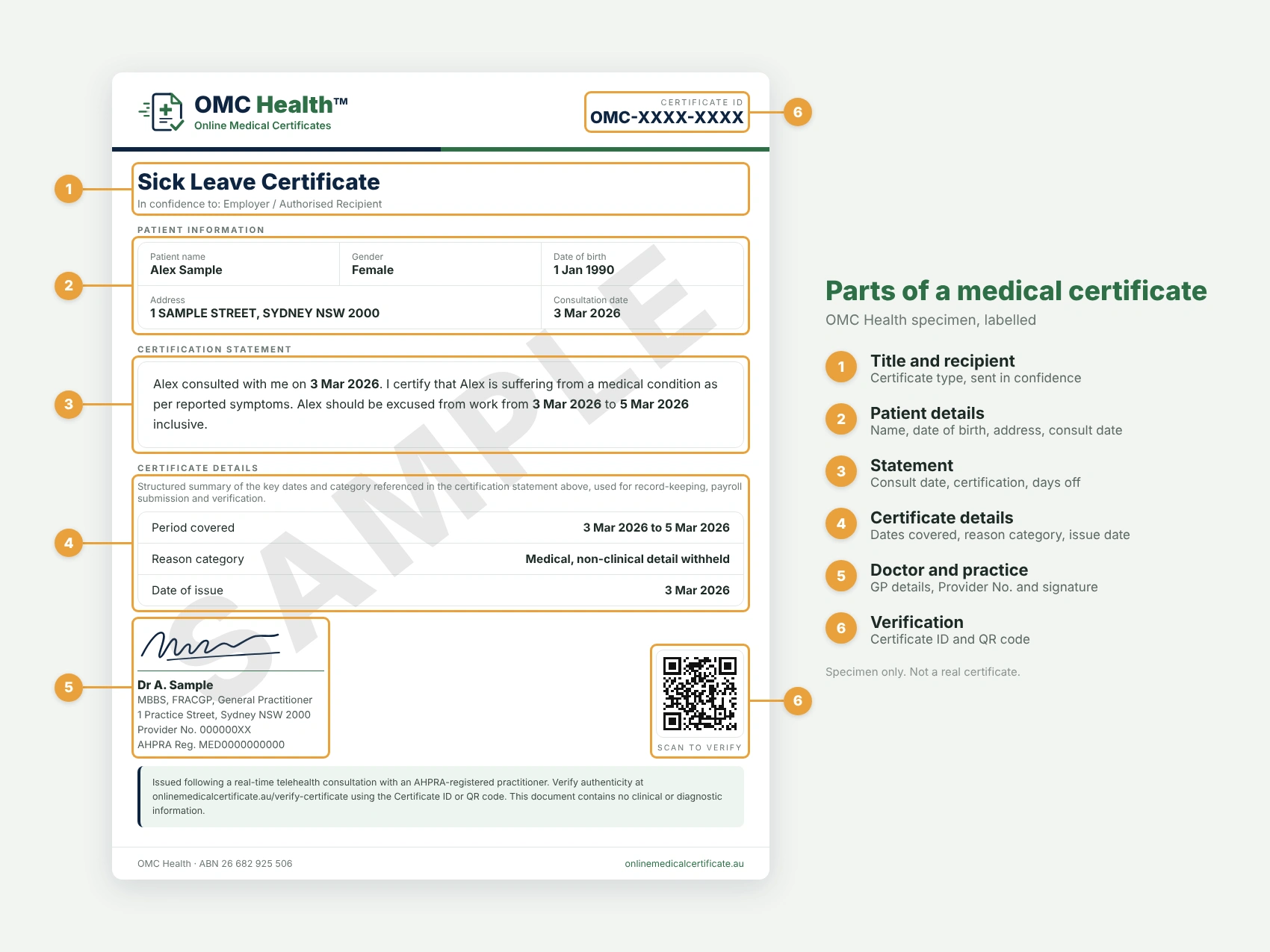
In practice, most certificates name the patient, say when the consult happened and give the dates covered. They also carry the doctor's details and signature. A sick leave certificate from OMC Health follows that pattern.
It matters because Fair Work says an employer can ask for evidence even when you've had one day or less off. Without it, that leave may go unpaid.
Fair Work leaves the layout open, but a health regulator has written down the contents. The NSW Health Professional Councils Authority lists what a medical certificate requires.
| Element | What it records |
|---|---|
| Practitioner | Name and address of the doctor issuing it |
| Patient | Name of the person certified |
| Examination | Date the examination took place |
| Incapacity | Degree of the patient's incapacity |
| Return to work | Date the doctor expects it to be possible |
| Recipient | Employer, insurer or other addressee |
| Signing | Date written and signed |
That's NSW guidance, so treat it as a reference point and not a national template.
Your employer needs to know you were unfit for work, and for how long. They don't usually need to know why.
That's why many certificates describe the reason in general terms. An OMC Health certificate records it as "Medical, non-clinical detail withheld", not a diagnosis.
The same guidance says a doctor should include diagnostic details only with the patient's consent. So the choice is yours. If your employer or insurer needs more, you can discuss it with the GP during the consult.
Employers can't be forced to accept the result, though. The authority says an employer can accept or reject a certificate whatever it contains.
Dates usually appear as a range, such as "from 3 March to 5 March inclusive". Inclusive means both the first and last day are covered. A single day reads "on 3 March".
On an OMC Health certificate, the consult date appears too, separate from the dates covered. A fitness for work certificate looks different. It states whether you can do full or modified duties, from which date, and any restrictions.
A certificate can also arrive after the first sick day. The NSW authority says a doctor may issue one once leave has begun, as long as it states the period they believe you were unfit. Doctors may decline if they aren't confident of the circumstances.
That's why a consult date and a covered period sit side by side. They record two different things.
One is when you were assessed. The other is which days the GP supports.
A verification ID or QR code can appear on any certificate, whether it's printed or sent digitally. Each OMC Health certificate carries both, so a printed copy can be checked too.
An employer can scan the code, or enter the ID to verify a medical certificate online. It confirms the certificate was genuinely issued, without showing your clinical details.
Reading the sample from top to bottom, you'll see these parts:
Title and recipient. "Sick Leave Certificate", addressed in confidence to your employer or another authorised recipient.
Patient details. Your name, gender, date of birth and address, with the consultation date.
Statement. Three short sentences: the consult date, the certification, and the dates you should stay off work.
Certificate details. The period covered, the general reason category and the date of issue.
Doctor and practice. The issuing GP's name, qualifications, practice address, Provider Number and Ahpra registration number, plus the GP's signature.
Verification. The certificate ID and QR code.
The GP leads the call and decides if a video check is needed. For a person under 18, a parent or guardian joins the consult. That consult comes first for every online medical certificate OMC Health issues.
Say you open the PDF in your inbox the minute it arrives. Start with your name, because a typo can cause questions later. Then read the dates twice. Does the range match the days you actually missed, and does it say "inclusive" where it should?
Remember what the reader is doing: weighing the document against Fair Work's reasonable person test. A certificate that names who, when and for how long answers the obvious questions before anyone asks them.
Next, look for the doctor's name and registration number, and the verification ID or QR code. Try the code on your own phone. If it opens the verification page, that's the check your employer would use. If you uploaded your own form at booking, check the completed form too, because it arrives with your OMC Health certificate.
Spot something wrong? Contact the service before you send it on. A corrected copy is easier than an explanation to HR later.
General information only, not a substitute for personalised advice; speak with a qualified practitioner.
A little. It's titled as a student certificate and addressed to your education provider. The statement excuses you from classes, exams and assessment deadlines for the dates covered. If you give your institution's name, it can appear as an extra row.
More detail than a sick leave certificate. It records the reported injury date, the period covered and your work capacity, plus any restrictions. Where an insurer needs its official certificate of capacity form, the treating practitioner completes that as well.
It means the ID entered doesn't match OMC Health's records. The document may have been altered, or it wasn't issued by OMC Health. Check the ID was typed correctly first. If it still isn't found, report it using the form on the verification page.
Slightly. A carer's certificate names you, not the person you're caring for, and states that you need to provide care or support. It also records your relationship to that person. Their name and clinical details don't appear. The dates and verification details work the same way.
Yes, provided a registered doctor issued it after a genuine assessment. Its weight comes from that assessment, not from whether it arrives by email or on paper. If your employer wants a hard copy, print the PDF. Keep the original email too, so you can forward it again if asked. It's the same test that decides whether online medical certificates are legal as evidence of leave.