Guide
Do Online Doctors Call Your Boss? Medical Privacy in Australia Explained
10 Sept 2026
Employers generally can't refuse a carer's leave certificate issued by an AHPRA-registered GP just because the consult happened online. Under the Fair Work Act, evidence only needs to satisfy a reasonable person that the leave was genuine, and a telehealth certificate meets that standard the same way an in-person one does.

A carer's leave certificate should provide evidence that supports your absence from work because you needed to care for or support an immediate family or household member.
Employers can ask for evidence that satisfies a reasonable person that the leave was genuinely needed. The question is not whether the certificate was issued online or in person, but whether it is genuine and reasonably supports the leave request.
This page explains what employers can request, what makes evidence reasonable, how certificate verification works, and what practical steps to take if evidence is questioned.
Evidence standard
Evidence should satisfy a reasonable person that the leave was genuine in the circumstances.
Medical certificates
A certificate from a registered practitioner can be used as evidence when appropriate.
Employers can request evidence that would satisfy a reasonable person that the leave was genuinely needed. This may include a medical certificate or statutory declaration depending on the circumstances.
Fair Work does not require one universal evidence format for every situation. The important factor is whether the evidence reasonably supports the employee's need to take leave.
A valid certificate should come from a registered practitioner after a genuine consultation and should clearly support the period where the employee needed to provide care or support.
The certificate does not need to include unnecessary details about another person's diagnosis. The focus is the employee's caring responsibility and the period of absence being supported.
Medical certificates are a standard form of evidence for personal and carer's leave, but Fair Work does not use a universal "must accept every certificate" rule.
The evidence needs to be reasonable in the circumstances and capable of satisfying a reasonable person that the employee was entitled to the leave.
An award, registered agreement or workplace policy may set out when evidence is required and what form it should take.
That does not make an online certificate inherently different. The practical questions are whether the evidence is genuine and whether it reasonably supports the absence.
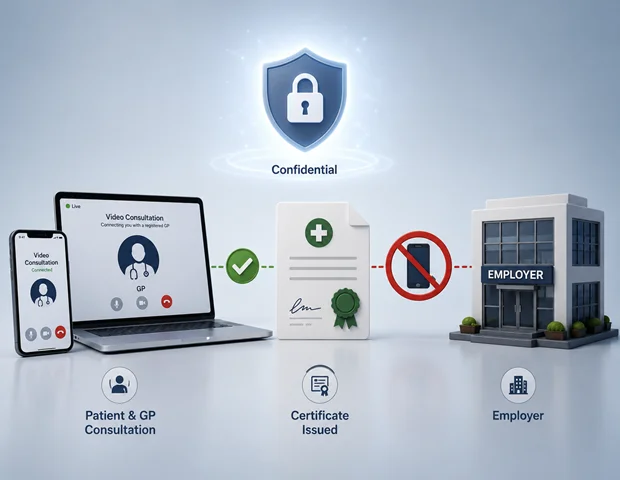
We operate as a platform that connects you with trusted Australian medical practices in three simple steps:
Select your medical certificate type on the OMC Health booking page and tell us a bit about your situation.
We connect you with an available AHPRA-registered GP from one of our partner practices for a real-time phone consultation.
If the GP determines it's clinically appropriate, your certificate is digitally issued and emailed the same day.
Book a real-time consultation with an AHPRA-registered GP. From 9.99.
If an employer questions a certificate, first use OMC Health's verification tool and the issuing practitioner's AHPRA registration details to confirm the certificate source.
If the disagreement is about leave evidence rules, check current Fair Work guidance rather than assuming a particular outcome before the circumstances are reviewed.
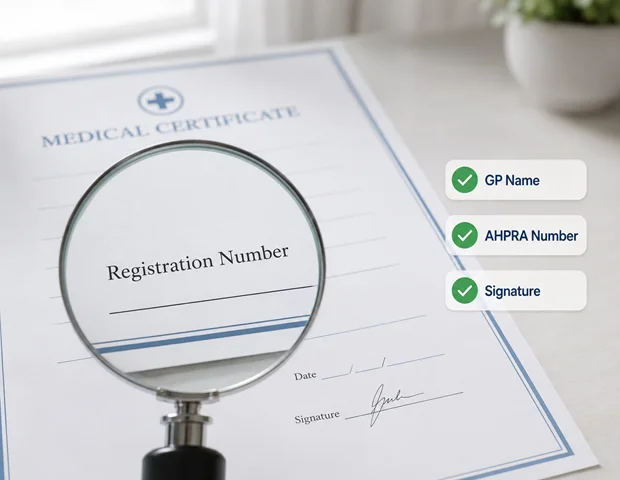
Employers can independently check whether the practitioner named on a certificate is registered by using the public AHPRA register.
This confirms the practitioner's registration status. Certificate verification separately confirms whether an OMC Health certificate was issued and matches the certificate details.
A genuine concern is based on something specific, such as evidence that a practitioner is not registered or signs that the document has been changed or misrepresented.
A general preference for in-person appointments or discomfort with telehealth alone does not determine whether evidence is reasonable.
If there is ongoing disagreement about evidence requirements, payment or leave handling, the Fair Work Ombudsman can provide guidance based on your specific circumstances.
The evidence standard for sick leave and carer's leave comes from the same Fair Work framework. The difference is the reason for the absence, not the basic approach to evidence.
A sick leave certificate supports your own illness or injury. A carer's leave certificate supports your need to provide care or support for someone else.
Sick leave certificate
Used when the employee is unable to work because of their own illness or injury.
Carer's leave certificate
Used when the employee needs time away from work to care for or support another person.
Keeping a copy of your certificate and noting the consultation date can make it easier to respond if questions arise later.
This is a practical record-keeping step and does not mean a dispute is expected. Having the relevant details available simply helps resolve questions more efficiently.
A certificate from an AHPRA-registered practitioner, issued after a genuine consultation and clearly stating the relevant period, can support a carer's leave request when it reasonably reflects the circumstances.
Employers can request reasonable evidence, but the assessment depends on the circumstances and applicable workplace rules.
Not simply for being online. An employer needs a genuine, specific reason to doubt the certificate's validity, such as evidence of fraud, rather than just a general preference for in-person visits over telehealth consults.
Raise it directly first, explaining the certificate meets the Fair Work reasonable-evidence standard. If that doesn't resolve the issue, the Fair Work Ombudsman can advise you on your specific situation and next steps.
No. A carer's leave certificate documents your caring role and the circumstances requiring your absence; it doesn't need to detail or prove your family member's specific diagnosis to satisfy the reasonable-evidence standard.
Not directly without your consent. Employers can verify a doctor's AHPRA registration on the public register, but they can't contact the GP to interrogate the clinical decision behind a certificate without your authorisation.
Employers generally can't refuse a carer's leave certificate issued by an AHPRA-registered GP just because the consultation took place online. Under the Fair Work Act, evidence only needs to satisfy a reasonable person that the leave was genuine, and a telehealth certificate meets that standard the same way an in-person one does.